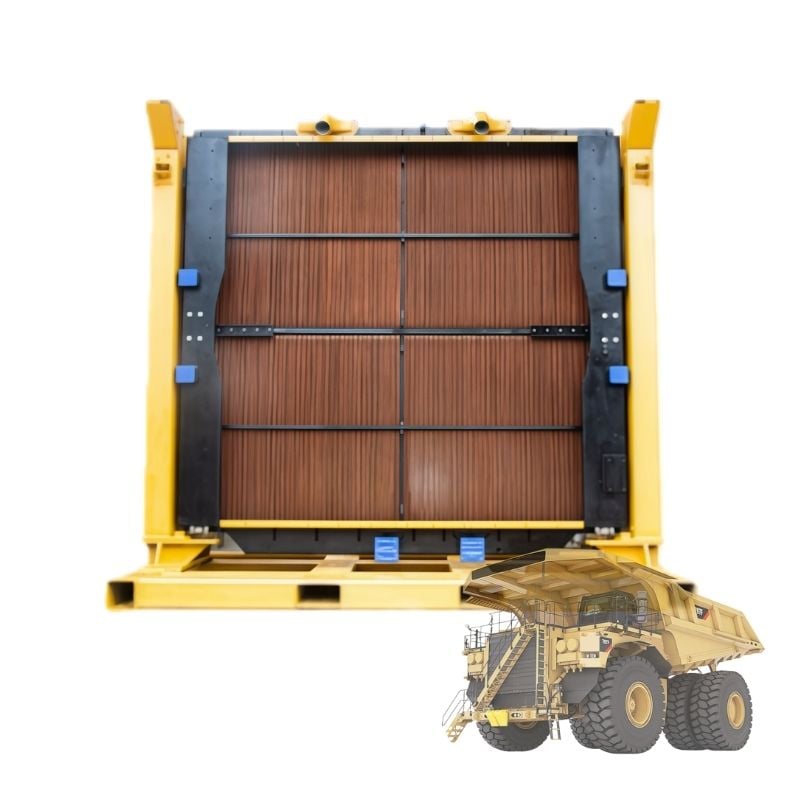
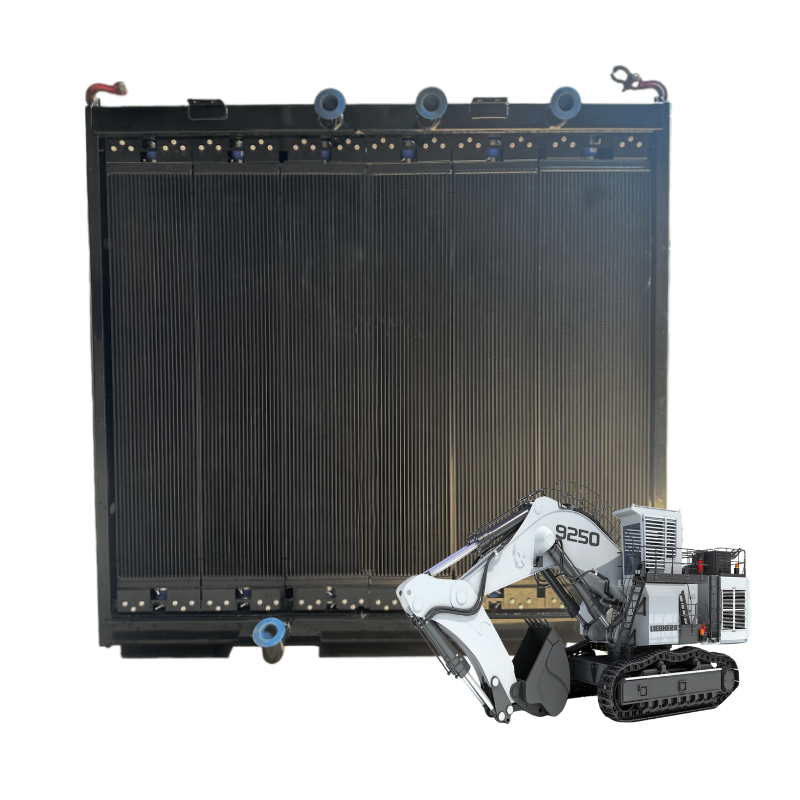
Understanding the cooling system that keeps generator sets running — and why the radiator is more critical than it looks.
A 1,000 kW generator set burns through a significant quantity of diesel every hour of operation. Less than 40% of that energy ever reaches the alternator as usable electrical output. The rest — the majority of the fuel's energy content — has to go somewhere. If the cooling system cannot move it out fast enough, the engine does not simply run hot. It shuts down, or fails.
So where does it actually go?
A diesel engine is not a perfect heat engine — no combustion engine is. Of every 100 units of energy released when fuel ignites inside the cylinders, the distribution typically looks like this:
~35–40 units Converted to mechanical work → electrical output via the alternator
~30–35 units Absorbed by the coolant and removed through the radiator
~25–30 units Expelled with exhaust gases
~3–5 units Radiated from the engine surface and lost to friction
In practical terms: for a continuously running generator set, the cooling system is handling a heat load that is comparable in magnitude to the electrical output it is producing. The radiator is not a secondary system. It is doing work on the same scale as the engine itself.
The process is continuous and cyclic. Combustion inside the cylinders generates heat that transfers to the engine block and cylinder head. Coolant circulating through the engine's internal water jackets absorbs this heat and rises in temperature. A water pump drives the heated coolant toward the radiator.
Inside the radiator, heat moves through a staged transfer: from the coolant, through the tube walls, into the fins, and finally into the airstream generated by the fan. The cooled coolant returns to the engine, and the cycle repeats — continuously, for as long as the engine runs.
Every component in this circuit has to keep pace with the engine's heat output. A pump that cannot move coolant fast enough, a thermostat that opens too late, or a radiator that cannot transfer heat into the airstream at the required rate — any one of these creates a bottleneck that the engine will eventually exceed.

The radiator is the point where accumulated heat finally exits the cooling circuit and enters the surrounding environment. Its performance determines the ceiling of what the entire system can handle.
Radiator capacity depends on more than physical size. The number of tube rows, fin density, fin and tube material, airflow volume, and fan compatibility all influence how much heat the unit can transfer per unit of time. These variables interact: increasing fin density improves surface area but raises air resistance and reduces flow. A larger core moves more heat but adds weight and may not fit the installation envelope.
Effective radiator design is not "bigger is always better." It is a balance between heat transfer rate, pressure drop, weight, and dimensional constraints — solved for a specific engine, a specific duty cycle, and a specific installation.
Heat transfer from a radiator to the surrounding air depends on the temperature difference between the two. The larger the gap, the faster heat moves across it.
Consider a system where coolant exits the engine at 90°C. In a 25°C ambient environment, the temperature differential driving heat transfer is 65°C. In a 40°C ambient — typical of summer conditions in the Middle East, sub-Saharan Africa, or an enclosed industrial facility — that differential shrinks to 50°C. The radiator now has to achieve the same heat transfer rate with roughly 23% less driving force.
This is not a marginal difference. It means a radiator that is correctly sized for a temperate climate may be genuinely undersized for the same engine operating in a high-ambient environment. The core structure, fin geometry, airflow, and material selection all need to account for the actual ambient conditions of the installation — not a standard reference temperature.
Matching a radiator to an engine is not a catalogue exercise. The same engine model running at standby duty in a temperate data center and at continuous prime duty in a desert-environment power plant requires a different cooling solution — different core dimensions, different fin density, potentially different materials.
At SINRUI, the starting point for any project is the actual operating condition, not a standard product list. Our engineering team works through the full heat transfer chain:
From this, we produce a radiator sized and built for the specific application — not a closest-available standard unit with a note that "performance may vary at elevated ambient temperatures."
Every unit goes through pressure testing and airflow verification before shipment. The design parameters and test results are documented with each delivery.
If you are sourcing a replacement or custom-built radiator for a generator set application, the following information allows our engineering team to assess the requirement accurately:
Not all of these may be immediately available. Send us what you have — our team can work with partial information and will follow up with any additional questions needed to complete the assessment.
📞 Phone / WhatsApp: +86 536 8590148
🌐 www.miningradiator.com
 Hot News
2026-10-12
2026-09-28
2026-09-27
2026-09-23
2026-09-17
2026-08-25
 EN
EN