A $5 decision that routinely triggers a $50,000 unplanned shutdown.
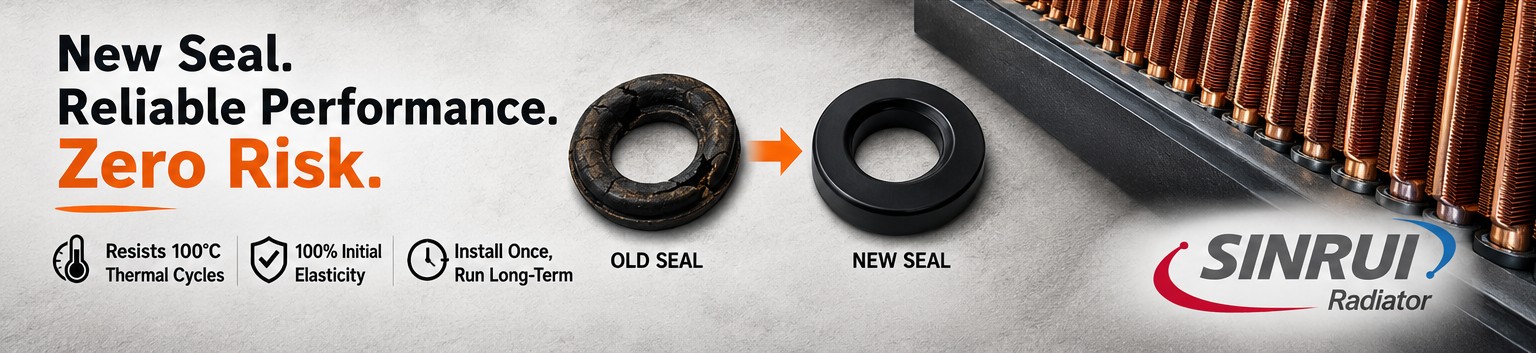
[IMAGE: Side‑by‑side comparison: new FKM seal (rounded cross‑section) vs. used seal (flattened, compressed)]
In the routine maintenance of removable tube radiators, technicians frequently face a familiar dilemma: the copper tube is perfectly intact, the rubber seal appears unbroken — so why not clean it and reinstall it to save costs?
The engineering answer is straightforward: a seal that looks intact is not the same as a seal that seals. The degradation that makes an old seal unreliable is internal, progressive, and largely invisible. By the time a leak appears, the decision to reuse has already been made — and the consequences are already in motion.
Seals inside a radiator header plate operate under continuous compression. The FKM (Fluorocarbon/Viton) rubber Sinrui specifies for its seals is selected specifically for its resistance to high temperatures — but no elastomer is immune to the long‑term effects of heat and sustained pressure.
The failure mechanism is called Compression Set. Under continuous loading at temperatures exceeding 100°C, the polymer chains within the rubber undergo an irreversible structural rearrangement. When the seal is removed from service, the cross‑section no longer returns to its original rounded shape. It retains a permanently flattened profile — the exact geometry of the gap it was compressed into.
When that seal is reinstalled around a new tube, the fit is wrong in a specific way: the seal has memorized the tolerances of the old tube, not the new one. The result is a gap of approximately 1mm in sealing contact — not enough to be visible during installation, but enough to initiate a leak under operating pressure.
A seal that has lost its elasticity does not fail immediately. It fails when the system is under load — at operating temperature, at operating pressure, at the worst possible moment for the machine.
Compression set is not the only degradation mechanism. In mining environments, coolant temperatures cycle continuously between cold start and full operating temperature — a range that can span 80°C or more within a single shift.
Each thermal cycle stresses the rubber at its most vulnerable points: edges, surfaces, and any location where the material has already begun to harden through oxidation. Over time, this cycling generates micro‑cracks — typically 0.1 to 0.3mm in width — that are below the threshold of visual inspection but well within the range that allows coolant to migrate under pressure.
There is a second, mechanical source of damage. When a copper tube is extracted during maintenance, the physical friction between the tube surface and the seal edge creates localized tearing at the seal lip — the precise surface responsible for the primary pressure seal. This damage is compounded if the tube is removed under any lateral load, which is common in field conditions where alignment is difficult to control.
A seal returned to service carries both forms of damage simultaneously: structural fatigue from thermal history and mechanical damage from the extraction process. Neither is visible during standard inspection. Both significantly increase the probability of failure under the next pressure cycle.
For a mine operator, the key metric is availability — the percentage of scheduled operating time the machine is actually running. Every unplanned stoppage is a direct subtraction from that figure.
The seal replacement decision looks like this:
| Reusing Old Seals | Replacing with New Seals |
|---|---|
| Seal has lost 30–50% of original elasticity due to compression set | 100% initial elasticity — full sealing pressure from first installation |
| Micro‑cracks present but invisible to the naked eye — failure is unpredictable | No prior heat or pressure history — failure risk is known and controlled |
| Short‑term saving: a few dollars per seal | Cost: ~$5 per seal |
| One field failure = shutdown, depressurization, draining, full disassembly. Cost: $50,000+ per incident | Install once, run long‑term. No unplanned stoppage from seal failure |
The failure scenario in the left column is not a worst case. It is the routine consequence of a seal that was marginal at reinstallation and reached its failure threshold under normal operating conditions. The shutdown, depressurization, draining, and disassembly sequence that follows is the same process that was just completed during the tube replacement — except now it is unplanned, it is in the field, and the machine has likely been running at operating temperature.
Based on Sinrui's field service records, seals that show visible compression set at inspection have a significantly elevated failure rate within the first 500 operating hours after reinstallation compared to new seals installed under the same conditions. The cost of prevention is $5. The cost of the failure it prevents is measured in hours of lost production.
The seal is the last line of defense between a functioning cooling system and an unplanned shutdown. At $5 per unit, it is also the lowest‑cost insurance in the maintenance budget.
Sinrui FKM seals are manufactured to match the exact dimensional and material specifications of Sinrui removable tube radiator cores. Each seal is supplied as new, with full elasticity and no prior compression or thermal history.
Want more insights on mining equipment cooling, supplier selection, and fleet reliability? Subscribe to our LinkedIn Newsletter for regular updates from the field.
Or reach out directly:
📞 +86 15684211561
🌐 www.miningradiator.com
 Hot News
2026-09-28
2026-09-27
2026-09-23
2026-09-17
2026-08-25
2026-08-20
 EN
EN