The rapid growth of artificial intelligence is reshaping how data centers are cooled. As AI workloads scale, the thermal power generated by next‑generation servers is reaching levels that traditional air cooling and evaporative systems are increasingly unable to handle.
This shift became concrete in mid‑2026, when NVIDIA published its Rubin‑generation reference design — a fully liquid‑cooled architecture built around high‑temperature glycol loops paired with outdoor dry coolers instead of chilled water or evaporative cooling towers. It's one of the clearest signals yet that dry coolers are moving from a supporting role to the core of AI data center heat rejection.
The biggest challenge for AI data centers is no longer only computing capacity — it is heat management.
As GPU performance climbs, rack power density is rising sharply. Single‑GPU thermal design power is already pushing toward 1,800–2,300W in next‑generation platforms, and peak rack densities in AI clusters can reach far beyond what traditional data centers were originally designed for.
Traditional air cooling struggles to keep up with this shift because:
To solve these challenges, next‑generation AI facilities are moving toward direct liquid cooling, where heat is transferred from chips through a liquid coolant loop before being rejected outdoors.
One of the key developments in advanced AI cooling is the adoption of high‑temperature closed‑loop glycol systems.
Instead of relying on chilled water or evaporative cooling towers, NVIDIA's Rubin reference design circulates glycol coolant at temperatures far higher than conventional chilled‑water loops — coolant enters the rack at roughly 45°C and exits around 55°C, a temperature differential wide enough that ambient air alone, via outdoor dry coolers, can reject the heat in most geographies without running energy‑intensive mechanical chillers.
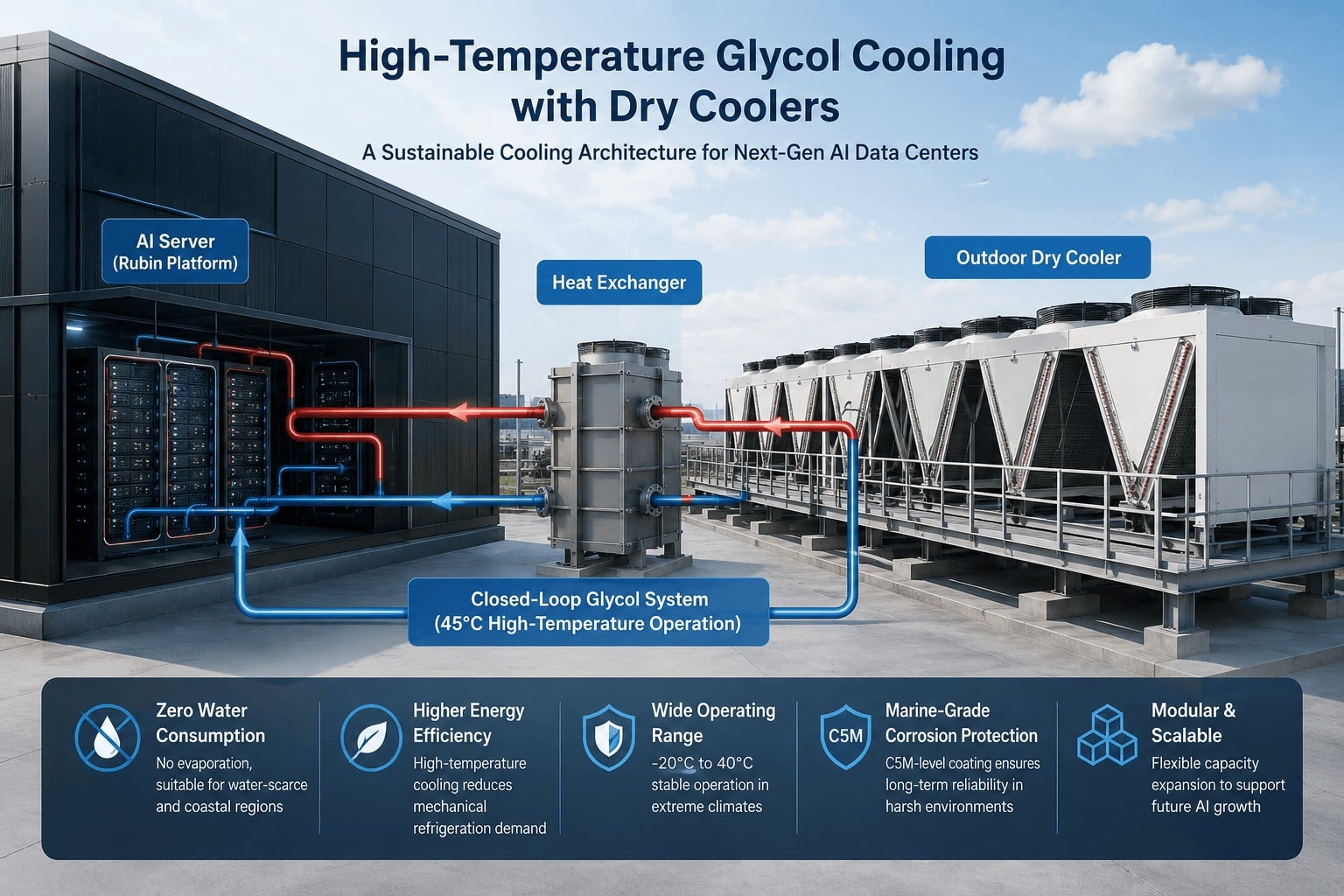
Architecture diagram: AI server rack to heat exchanger to outdoor dry cooler in a closed‑loop glycol system
The efficiency case is substantial: cooling typically accounts for up to 40% of a data center's total electricity consumption, and raising chiller plant operating temperature by just one degree can cut cooling energy costs by roughly 4%. Running the loop hotter also means the higher the coolant temperature, the greater the opportunity for direct heat rejection through dry coolers rather than mechanical refrigeration.
Zero Evaporation Water Consumption
Unlike cooling towers, closed‑loop glycol systems don't rely on continuous water evaporation. NVIDIA estimates its Rubin data center design can save roughly 2.6 million gallons of water per megawatt annually compared with conventional evaporative cooling — removing water availability as a site‑selection constraint entirely. We cover the water‑saving mechanics in more detail in our guide on dry coolers and data center water consumption.
This makes closed‑loop glycol systems particularly suitable for:
As AI infrastructure evolves, dry coolers are becoming more than a traditional heat exchanger — they're becoming a critical part of the entire cooling architecture, not an auxiliary component bolted on afterward.
V‑Type Modular Dry Coolers
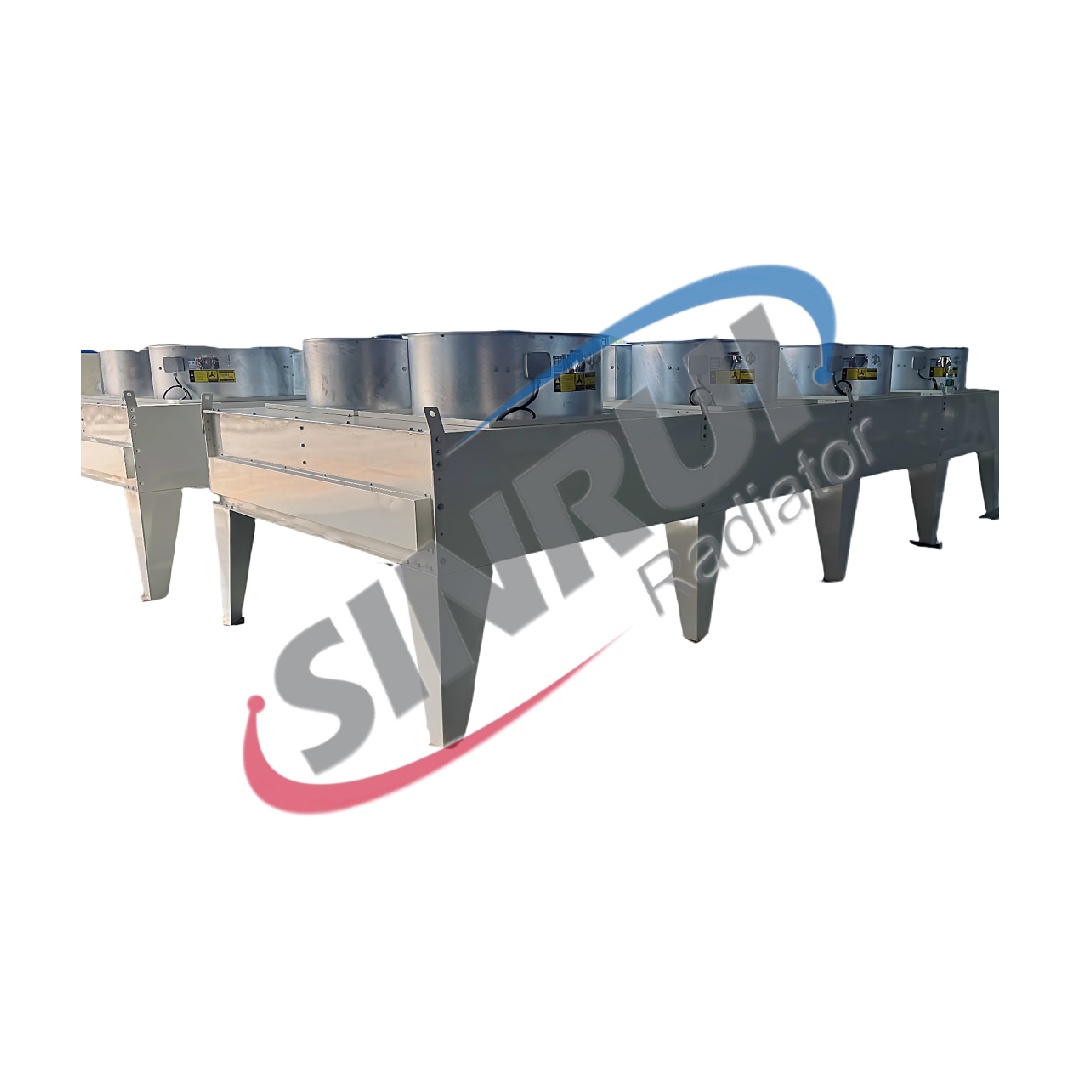
For high‑density AI applications, V‑type modular dry coolers offer particular advantages: they maximize heat exchange surface area while maintaining a compact footprint, provide high cooling capacity with flexible installatio n, reduce land requirements, and allow easy capacity expansion through modular configuration as compute demand grows.
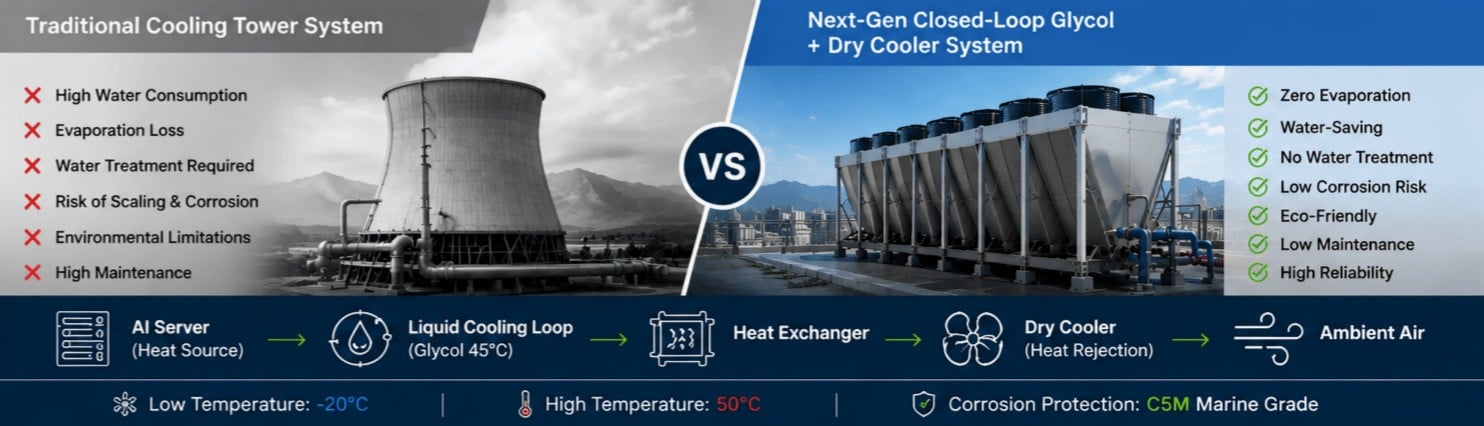
Comparison of a traditional cooling tower system versus a next‑generation closed‑loop glycol and dry cooler system, with a heat rejection flow diagram
Designed for Extreme Climate Conditions
Future AI data centers won't only be located in traditional technology hubs — many large‑scale AI facilities are being developed in regions with challenging climates, so cooling systems need to support wide operating temperature ranges.
Modern dry cooling solutions are designed for stable operation from roughly –20°C (with proper freeze protection) up to around 40°C ambient, with long‑term reliability in harsh outdoor environments. For coastal and industrial locations, marine‑grade corrosion protection such as C5M‑level coatings is increasingly specified for equipment exposed to salt spray and aggressive atmospheres — see our dry cooler core protection solution for high‑corrosion conditions for material options in these environments.
AI development is moving faster than traditional data center planning cycles, so cooling systems need to be flexible enough to expand alongside rising computing demand.
Modular dry cooler systems provide that flexibility. Instead of relying on one large cooling unit, operators can install multiple modules and add capacity incrementally as AI workloads grow — offering easier transportation and installation, faster project deployment, reduced maintenance risk (since one module can be serviced without shutting down the whole system), and scalable cooling capacity that tracks compute growth rather than requiring it to be forecast years in advance.
Facilities running dry coolers at this scale increasingly pair them with continuous condition monitoring — our guide on smart dry coolers and IoT remote monitoring covers how IoT sensors catch fan, coil, or airflow issues before they affect uptime.
Does high‑temperature liquid cooling mean dry coolers replace mechanical chillers entirely?
Not always, but the goal is to minimize reliance on them. Because the Rubin‑class reference design runs coolant substantially hotter than conventional chilled‑water loops, dry coolers can reject that heat directly to ambient air across a much wider range of climates and seasons — mechanical cooling becomes a backup for extreme peak conditions rather than the primary heat rejection method.
Can existing data centers retrofit dry coolers for high‑temperature liquid cooling, or does it require new construction?
Both are possible, but the practicality depends on the existing cooling infrastructure. Facilities already using a liquid cooling loop with a heat exchanger and outdoor heat rejection equipment have an easier path; those still relying entirely on air cooling or evaporative towers typically need a more significant infrastructure redesign.
How does high‑temperature glycol cooling affect dry cooler sizing compared to standard applications?
A wider approach temperature (the gap between coolant temperature and ambient air) generally makes it easier for a dry cooler to reject a given heat load, since the driving temperature difference is larger. That said, sizing still needs to account for glycol concentration, which affects fluid properties — see our dry cooler capacity calculation guide for the underlying method.
The next generation of AI servers will require more than powerful processors — they will require equally advanced cooling infrastructure. High‑temperature glycol liquid cooling combined with V‑type modular dry coolers represents a major direction for future AI data centers, and NVIDIA's Rubin reference design is accelerating that shift across the industry.
SINRUI Radiator develops customized cooling solutions for demanding applications, including dry coolers, liquid cooling heat exchangers, and industrial radiator systems. As AI computing continues to accelerate, efficient heat rejection will be one of the most important factors determining the reliability, sustainability, and scalability of future data centers.
The future of AI is not only about faster chips — it is also about smarter cooling.
 Hot News
2026-10-12
2026-09-28
2026-09-27
2026-09-23
2026-09-17
2026-08-25
 EN
EN