Undersized, and your process fluid runs hot. Oversized, and you've paid more than you needed to — in capital cost and fan energy every year. Getting dry cooler capacity right starts with the numbers, and this guide walks through the calculation step by step.
How do you calculate the required dry cooler capacity?
Oversizing increases investment and operating costs, while undersizing can lead to high fluid temperatures, reduced equipment efficiency, and even system shutdowns. This guide explains the calculation process in a practical, engineering-focused way.
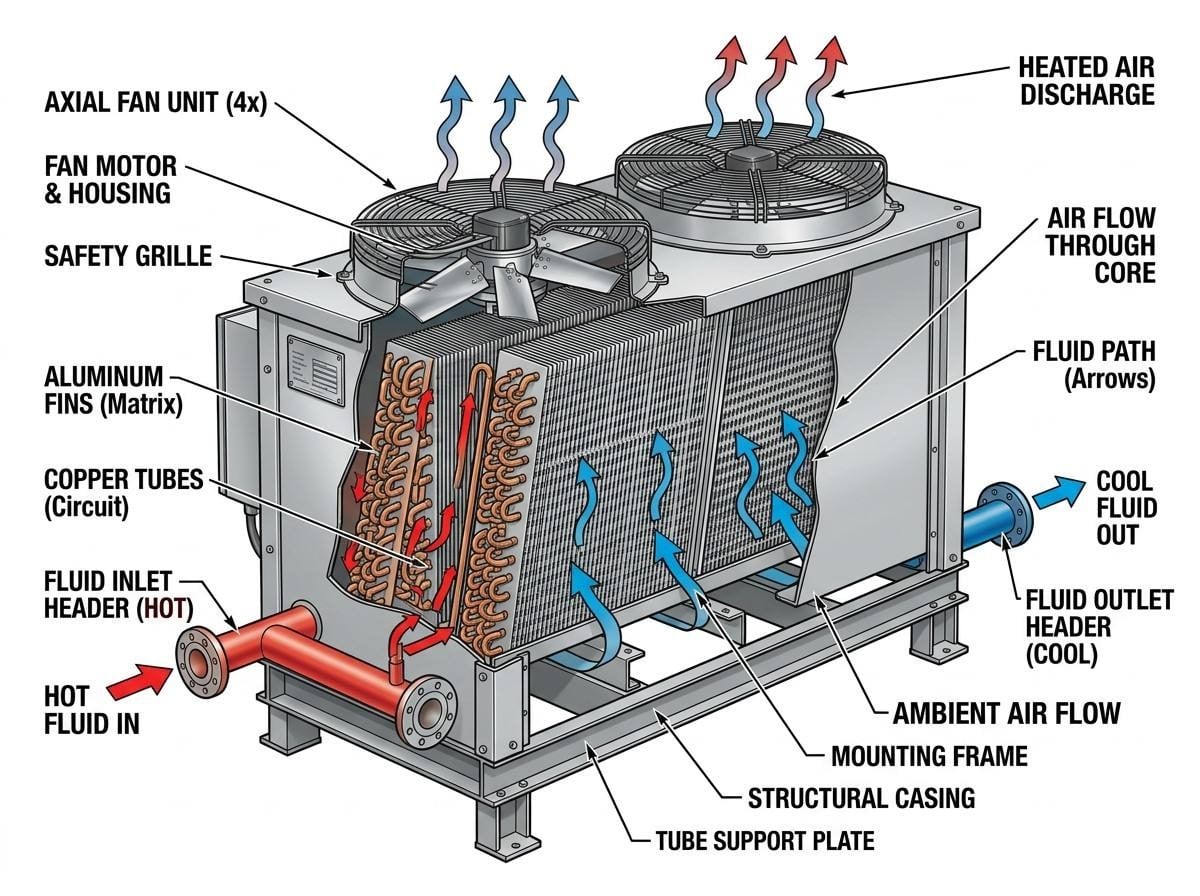
Dry cooler capacity refers to the amount of heat the unit can remove from a circulating fluid using ambient air.
The cooling capacity is typically expressed in:
The basic heat transfer equation is:
Q = m × Cp × ΔT
Where:
This equation forms the foundation of every dry cooler design.
The first step is identifying how much heat must be rejected.
If the equipment power is known:
Heat Load (kW) ≈ Equipment Heat Generation
Examples:
If the fluid flow and temperatures are known, calculate:
Q = m × Cp × ΔT
Example
Water flow rate:
15 kg/s
Water inlet temperature:
40°C
Water outlet temperature:
32°C
Specific heat of water:
4.186 kJ/kg·K
Calculation:
Q = 15 × 4.186 × (40−32)
Q = 502 kW
The dry cooler should therefore dissipate approximately 500 kW of heat.
Different fluids transfer heat differently.
Common cooling fluids include:
| Fluid | Typical Specific Heat (kJ/kg·K) |
|---|---|
| Water | 4.186 |
| Water-Glycol 20% | ~3.95 |
| Water-Glycol 30% | ~3.80 |
| Water-Glycol 40% | ~3.65 |
| Thermal Oil | 1.8–2.5 |
Higher glycol concentrations reduce heat transfer performance, meaning larger heat exchangers are generally required.
Three temperatures are essential:
Example:
Fluid Inlet: 40°C
Fluid Outlet: 32°C
Ambient Air: 30°C
The smaller the temperature difference between the fluid and ambient air, the larger the dry cooler required.
This temperature difference is commonly referred to as the approach temperature.
Approach Temperature:
Fluid Outlet − Ambient
= 32 − 30
= 2°C
A smaller approach means the dry cooler must provide more surface area and airflow to achieve the same cooling duty.
Heat removed by the dry cooler is carried away by air.
The airflow equation is:
Q = Air Mass Flow × Air Cp × Air Temperature Rise
Although software typically performs this calculation automatically, engineers should understand that:
Proper airflow management is especially important in hot climates and confined installation spaces.
Ambient temperature has a major impact on dry cooler performance.
Typical design ambient temperatures include:
| Region | Typical Design Ambient |
|---|---|
| Northern Europe | 30°C |
| Middle East | 45–50°C |
| Southeast Asia | 35–40°C |
| North America | 35–40°C |
Selecting a dry cooler based on unrealistically low ambient temperatures can result in insufficient cooling during peak summer conditions.
Cooling capacity alone is not enough.
The system should also satisfy allowable pressure loss.
A pressure drop that is too high may:
The radiator design should balance both heat transfer performance and hydraulic resistance.
Most engineers include a reasonable safety margin to account for:
A typical design margin of 5–15% is often sufficient, depending on the application. Excessive oversizing should be avoided because it increases both capital cost and fan energy consumption.
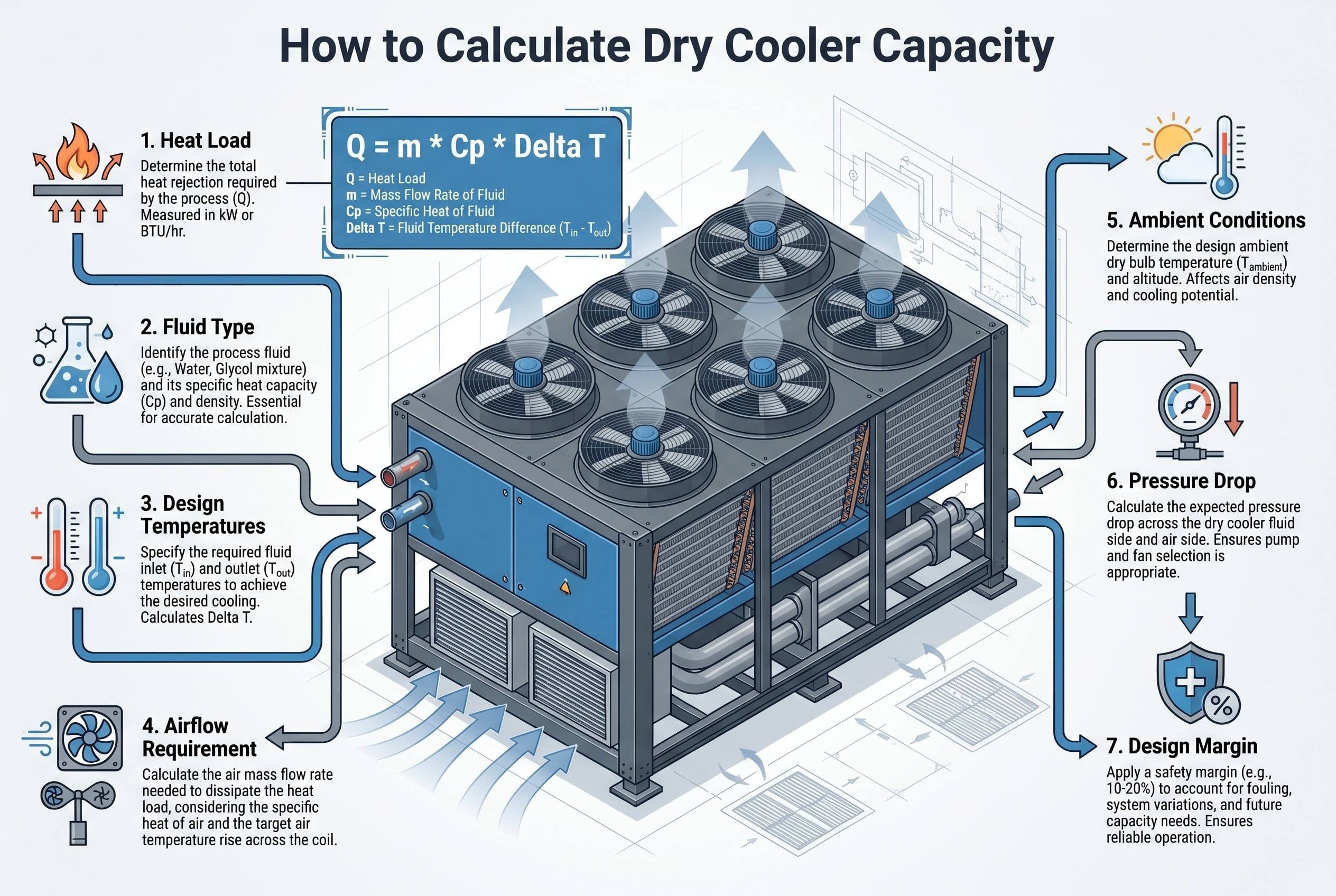
Let's put everything together.
Design Conditions
From these conditions, engineers can determine:
In practice, manufacturers use thermal design software and performance testing to optimize these parameters while ensuring the required cooling capacity is achieved.
Many sizing problems originate from incomplete or inaccurate input data. Common mistakes include:
Providing complete operating conditions helps manufacturers deliver a more accurate and cost-effective design.
To size a dry cooler accurately, prepare the following information:
The more complete the data, the more precise the equipment selection.
What is a good approach temperature for a dry cooler?
An approach temperature of 3–8°C is typical for most industrial and commercial applications. A tighter approach (1–3°C) requires significantly more heat transfer surface area and increases equipment cost. For most projects, 5°C is a practical starting point — your manufacturer can advise based on your specific heat load and ambient conditions.
Can dry coolers work with glycol mixtures?
Yes. Glycol-water mixtures are commonly used in dry coolers for freeze protection. However, higher glycol concentrations reduce specific heat capacity and increase viscosity, which lowers heat transfer performance and may increase pressure drop. Always specify your glycol concentration when requesting a dry cooler quotation — a unit sized for pure water will underperform if glycol is added later.
How does ambient temperature affect dry cooler sizing?
Ambient temperature directly limits the minimum achievable fluid outlet temperature. If your design ambient is too conservative (set too low), the dry cooler will not deliver adequate cooling during peak summer conditions. Always use the realistic maximum ambient temperature for your site — not the annual average.
Need help sizing a dry cooler for your project? Explore SINRUI's dry cooler range or read the Dry Cooler Selection Guide — and contact our engineering team with your operating conditions for a site-specific recommendation.
Calculating dry cooler capacity is more than choosing a heat exchanger with the highest cooling rating. Engineers must evaluate heat load, fluid properties, operating temperatures, ambient conditions, airflow, and hydraulic performance together to achieve a reliable and efficient solution.
SINRUI dry coolers are sized from actual operating data — heat load, fluid properties, design temperatures, and site ambient conditions — rather than standard catalog ratings. If you'd like a capacity calculation for your specific application, contact our engineering team.
Whether you're designing a data center cooling system, an industrial process, or a power generation application, accurate capacity calculations are the first step toward selecting the right dry cooler.
 Hot News
2026-09-28
2026-09-27
2026-09-23
2026-09-17
2026-08-25
2026-08-20
 EN
EN