The materials science and customization logic behind mining dump bodies that actually last.
[IMAGE: Komatsu 930E or CAT 797 haul truck with dump body raised at active mine site]
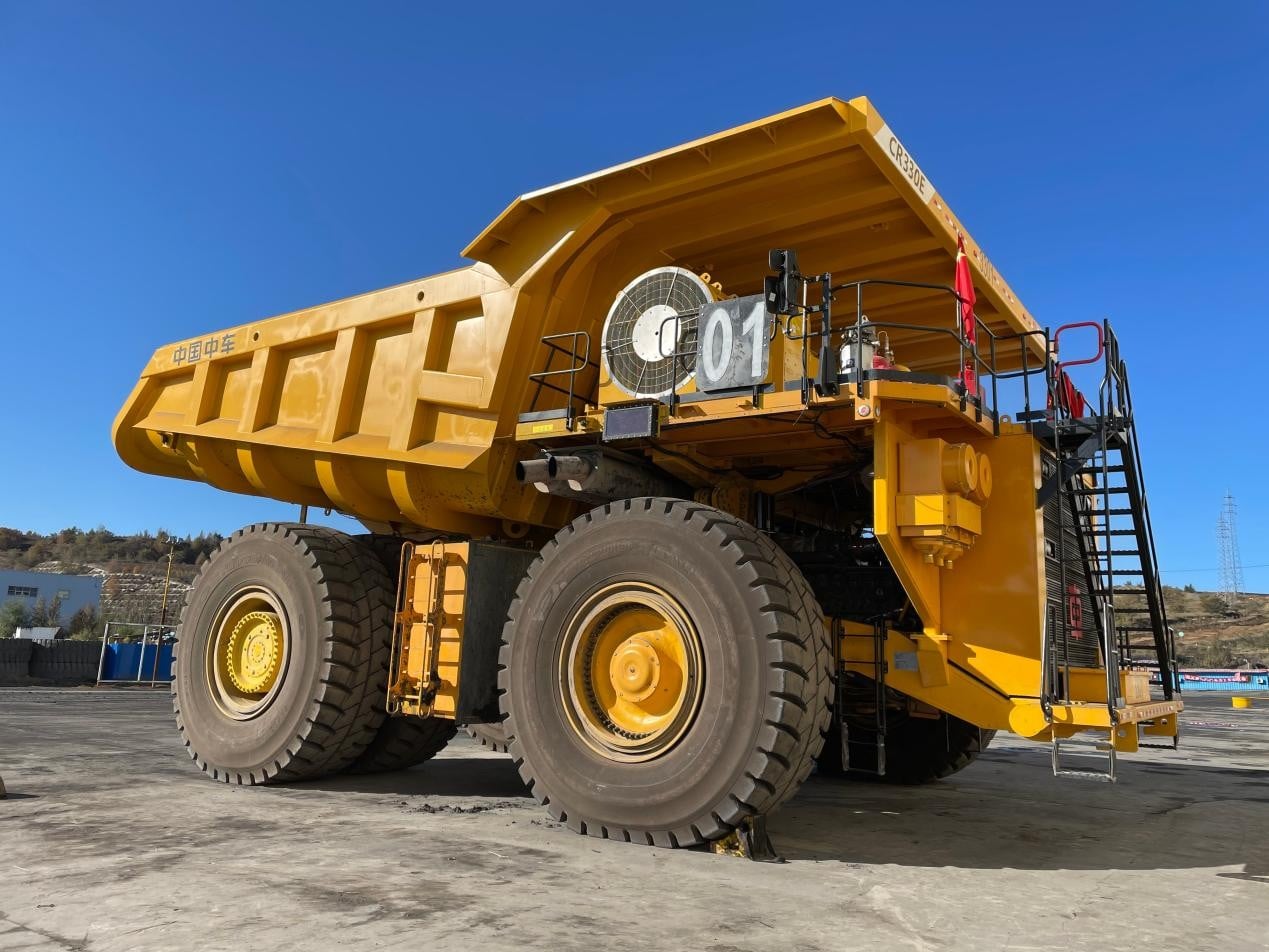
When standing before a haul truck like the Komatsu 930E or CAT 797, the dump body is impossible to ignore. To most observers, it reads as a large steel box — the assumption being that thickness and mass are what matter.
To engineers who specify and maintain these components, that assumption is exactly what leads to premature failure. Dead weight is the enemy of payload efficiency. Real strength comes from the combination of the right material, the right geometry, and a design calibrated to the specific ore being hauled.
Not all dump bodies are built to that standard. This article explains what separates the ones that are.
A haul truck body absorbs thousands of rock impacts every operating day. At the point of impact, the force is concentrated, localized, and repeated. Standard carbon steel deforms under this loading pattern — first through surface wear, then through structural fatigue.
The solution is wear‑resistant steel, and the key to selecting it correctly is understanding that hardness and toughness are not the same property — and that a dump body needs both.
Hardness: resisting abrasion
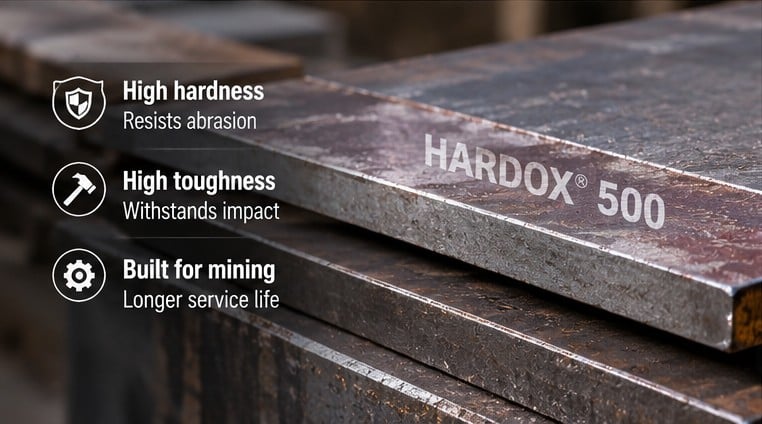
Premium wear‑resistant grades such as Hardox 450 and Hardox 500 offer a Brinell hardness (HB) three to four times that of standard structural steel. This hardness directly resists the cutting and grinding action of sharp ore on the body floor and side plates — the first surfaces to wear through in hard‑rock operations.
[IMAGE: Cross‑section or close‑up of Hardox wear‑resistant steel plate showing material structure]
Toughness: absorbing impact without cracking
Hardness alone is brittle. A dump body that is too hard will crack under the high‑kinetic‑energy impacts of large boulders falling from height. The material needs to absorb that energy — to flex under load and return to shape rather than fracture.
This is why wear‑resistant steel for mining applications is specified not just by hardness rating, but by its impact toughness at operating temperatures. A body that holds up in a temperate Indonesian open‑pit mine may crack in a high‑altitude Andean operation where temperatures drop sharply overnight.
Selecting a dump body on weight and price is equivalent to selecting a radiator on physical dimensions alone. The number on the spec sheet is the starting point — the material behaviour under operating conditions is what determines service life.
No single dump body design handles every material type optimally. Mine managers in Chile, Australia, and Indonesia have reached the same conclusion independently: the ore determines the body, not the other way around.
1. Hard rock: iron ore, gold, copper
[IMAGE: Dump body designed for hard rock operations showing reinforced side plates and rib structure]
In hard‑rock operations, abrasion is the primary wear mechanism. Sharp, angular fragments concentrate stress at the same points on the body floor and lower side walls with every load cycle.
Design approach: Increased plate thickness in high‑impact zones, combined with a multi‑point supported rib structure that distributes stress across the frame rather than concentrating it at welds
Practical outcome: Extended refurbishment intervals and reduced unplanned downtime caused by floor punctures — the most common failure mode in iron and gold mining applications
2. Sticky material: clay‑heavy and wet conditions
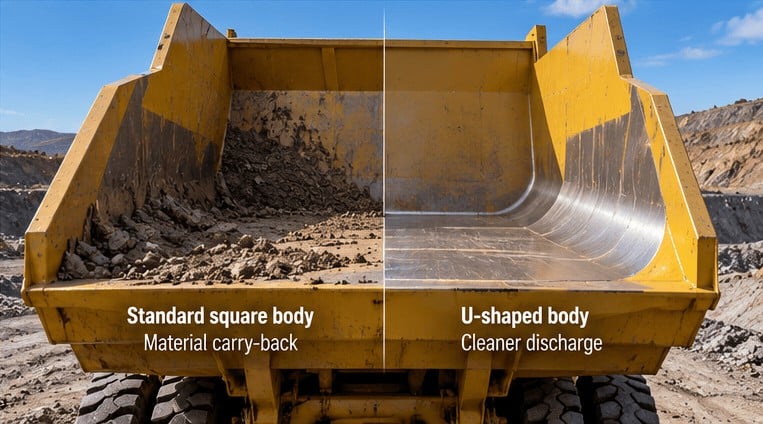
In operations where ore has high clay or shale content — particularly in wet seasons — material carry‑back becomes a significant operational cost. Between 10 and 15 percent of the load typically remains in the corners of a standard box‑shaped body after tipping. This residual material is deadweight on every return trip: it reduces effective payload, accelerates wear at accumulation points, and consumes fuel that generates no revenue.
Geometry solution: U‑shaped bodies or large‑radius rounded corners eliminate the angular dead zones where material accumulates. Under gravity alone, material that would stick in a square corner discharges cleanly from a radiused surface
Thermal solution: Engine exhaust heating systems route waste heat to the floor plate, raising its surface temperature enough to break the adhesive bond between wet clay and steel. This is particularly effective in low‑temperature operating environments where clay stiffens overnight
3. Bulk coal: maximising payload within axle limits
Coal's low bulk density creates the opposite problem: a standard body reaches its volumetric limit long before approaching the truck's rated payload capacity. The body runs full but the truck runs light — structural capacity is being left on the table with every cycle.
Design approach: High‑strength steel enables a lightweight body construction with substantially increased side plate height. The reduced body weight directly converts to additional payload capacity within axle load limits
Practical outcome: Single‑trip transport volume increases of 15 percent or more are achievable without exceeding rated gross vehicle weight — recovering payload efficiency that a standard body design leaves unused
The acquisition price of a dump body is straightforward to compare. The total cost of ownership is not.
A body specified for the wrong ore type wears through faster, requires more frequent refurbishment, and generates more unplanned downtime. In a high‑utilization mining operation, each unplanned stoppage carries a downtime cost that dwarfs the price difference between a standard and a correctly specified body.
The variables that determine long‑term cost are the ones that don't appear in a standard quotation: material grade and traceability, weld quality at high‑stress joints, corrosion protection on the frame, and whether the geometry is matched to the actual material being hauled.
Buying a dump body by weight and price is a transaction. Specifying one correctly is an engineering decision — and the difference shows up in the production numbers within the first operating year.
"Selecting a dump body should not be a transaction of buying iron by the ton. It is an investment in hauling efficiency."
Sinrui designs and supplies custom dump body solutions for Caterpillar, Komatsu, and other major haul truck platforms. Each specification is engineered to the ore type, operating environment, and payload requirements of the application.
To discuss a custom specification for your fleet, contact us directly:
📞 +86 15684211561
🌐 www.miningradiator.com
 Hot News
2026-09-17
2026-08-25
2026-08-20
2026-08-14
2026-08-12
2026-07-31
 EN
EN