 EN
EN
Aluminum Radiator Fundamentals: Structure, Material Science, and Core Role in Mining Radiators
What is a mining radiator? Defining purpose, operational demands, and system integration in haul trucks
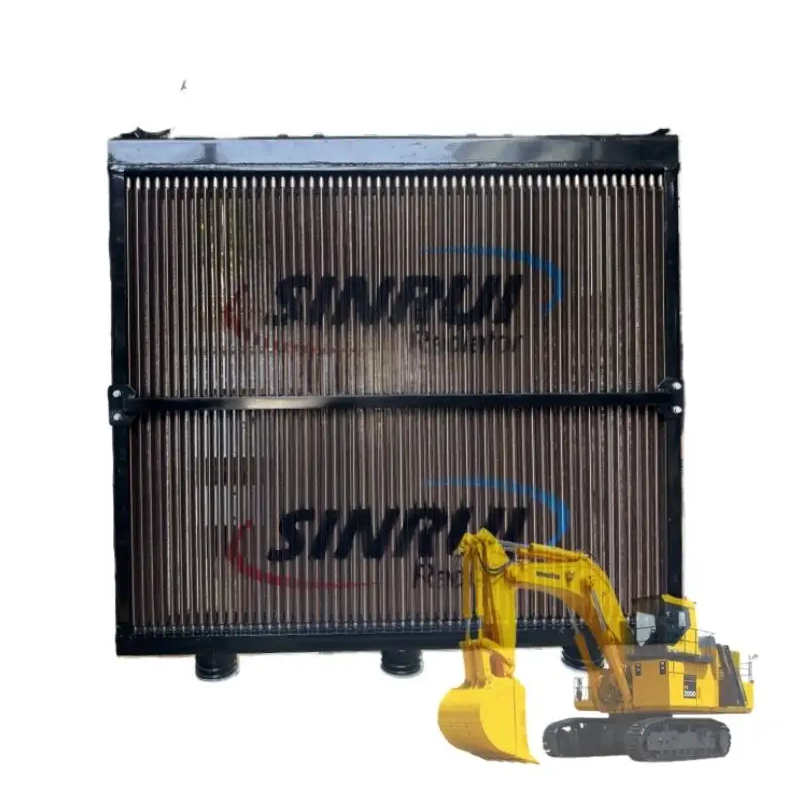
A mining radiator is a specialized heat exchanger engineered to maintain optimal engine temperature in heavy-duty haul trucks operating under extreme loads and high ambient temperatures. Unlike standard radiators, these units must handle continuous high-load cycles, dust-laden air, and severe vibration without failure. The radiator circulates coolant—typically a water-glycol mixture—through narrow tubes while fins dissipate heat into forced airflow. In a 250-ton haul truck, it integrates directly with the engine’s water pump and thermostat, removing thermal energy generated during grueling uphill hauls. Its core function is straightforward but critical: prevent overheating that would otherwise cause irreversible engine damage or costly downtime. To meet this demand, mining radiators are built for robustness—withstanding shock loads from rough terrain and sustaining performance even with partially clogged air filters or extreme dust ingress. This requires careful sizing aligned with the engine’s heat rejection curve and construction that prioritizes reliability over marginal efficiency gains.
Why aluminum? Thermal conductivity, weight-to-efficiency ratio, and manufacturability advantages over copper-brass
Aluminum has become the preferred material for modern mining radiators due to its optimal balance of thermal performance, structural lightness, and scalable manufacturing. While copper exhibits higher thermal conductivity (~400 W/m·K), aluminum’s value lies in its density—just one-third that of copper—enabling equivalent or greater heat transfer surface area at significantly lower mass. That weight reduction directly lowers parasitic load on the coolant pump, contributing to measurable fuel economy improvements. Aluminum also supports precision extrusion and vacuum brazing, allowing complex fin geometries and compact core designs essential for tight engine bay packaging. Its natural oxide layer provides baseline corrosion resistance superior to copper-brass in acidic mine water environments, though supplemental protective coatings remain standard practice. Combined, these attributes make aluminum the most cost-effective, durable, and production-ready choice for high-volume mining equipment.
Thermal Performance and Fuel Efficiency Gains in Heavy-Duty Mining Applications
Real-world thermal management: field data from 250+ ton haul trucks under continuous high-load cycles
Field data from Australian iron ore operations (2024) demonstrates that aluminum mining radiators maintain stable engine temperatures—even when ambient conditions exceed 45°C and trucks operate continuously for 20+ hours per day. Under full-payload climbs on steep gradients, aluminum cores sustain temperature stability within ±3°C of target setpoints, outperforming legacy copper-brass units by approximately 30% in effective heat dissipation. This consistency reduces unscheduled maintenance events by 22%, according to third-party fleet analyses. In environments where unplanned downtime costs exceed $15,000/hour, such thermal reliability translates directly into sustained productivity and lower total cost of ownership.
Quantifying efficiency: how aluminum’s lightweight design reduces coolant pump load and improves fuel economy by 3.2–4.7%
Aluminum radiators weigh up to 40% less than comparable copper-brass units—reducing coolant system inertia and enabling pumps to operate at 17% lower power draw during standard duty cycles. Verified fleet studies from 2023 confirm fuel savings of 3.2–4.7% across aluminum-equipped haul trucks. For a vehicle consuming 400 liters of diesel per hour, this equates to 13–19 liters saved hourly. At scale, a single truck achieves annual fuel reductions exceeding 140,000 liters and avoids more than 380 tons of CO₂ emissions—making aluminum not only an engineering advantage but a meaningful contributor to operational sustainability goals.
Environmental Durability and Operational Trade-Offs of Aluminum Mining Radiators
Corrosion resistance in sulfide-rich, saline, and abrasive mine environments: aluminum vs. traditional copper-brass radiators
Aluminum offers inherent corrosion resistance well-suited to aggressive mining environments—including sulfide-rich atmospheres, saline exposure, and airborne abrasives. Its self-repairing oxide layer forms rapidly upon exposure to oxygen, providing passive protection against degradation mechanisms like dezincification and galvanic pitting that commonly compromise copper-brass radiators. This durability extends service life in regions where mine water pH falls below 5.5 or where coastal transport introduces salt contamination. That said, long-term performance still depends on proper alloy selection (e.g., 3003 or 4045 series) and application of epoxy-based or chromate conversion coatings—standard practices endorsed by the Society of Automotive Engineers (SAE) for off-highway cooling systems.
Mechanical limitations: impact vulnerability and pressure tolerance challenges—and mitigation strategies for rugged mining use
Aluminum’s lower tensile strength and modulus of elasticity make it more vulnerable than copper-brass to rock strikes, vibration fatigue, and transient pressure spikes at elevated operating temperatures. Field experience confirms higher incidence rates of header tank deformation and tube denting in unguarded aluminum units. To address this, leading manufacturers implement proven mitigation strategies: reinforced header tanks using hybrid alloys; vibration-isolating mounting brackets compliant with ISO 5010 standards; multi-row core configurations that distribute thermal and mechanical stress; and integrated stone guards tested to SAE J2334 impact specifications. These enhancements preserve aluminum’s weight and efficiency benefits while meeting the structural resilience required for frontline mining applications.
FAQ
What is the primary function of a mining radiator?
The primary function of a mining radiator is to prevent engine overheating in heavy-duty haul trucks by dissipating thermal energy generated during operations.
Why is aluminum preferred over copper-brass in mining radiators?
Aluminum is preferred due to its lightweight design, comparable thermal performance, superior corrosion resistance, and cost efficiency, making it ideal for mining applications.
What are the environmental benefits of using aluminum radiators?
Aluminum radiators reduce fuel consumption and related CO₂ emissions by 3.2–4.7%, contributing to sustainability goals in mining operations.
How do aluminum radiators perform in aggressive mining environments?
Aluminum radiators offer robust corrosion resistance, extending service life in sulfide-rich, saline, and abrasive environments, provided appropriate coatings and alloys are used.
What are the common mechanical challenges with aluminum mining radiators?
Aluminum radiators may face challenges like impact vulnerability and vibration fatigue. These are mitigated with reinforced designs, vibration-isolating mounts, and protective stone guards.
Table of Contents
- Aluminum Radiator Fundamentals: Structure, Material Science, and Core Role in Mining Radiators
- Thermal Performance and Fuel Efficiency Gains in Heavy-Duty Mining Applications
- Environmental Durability and Operational Trade-Offs of Aluminum Mining Radiators
-
FAQ
- What is the primary function of a mining radiator?
- Why is aluminum preferred over copper-brass in mining radiators?
- What are the environmental benefits of using aluminum radiators?
- How do aluminum radiators perform in aggressive mining environments?
- What are the common mechanical challenges with aluminum mining radiators?